
Since 2013, Eco-mobilier has been collecting bedding from health and medico-social establishments free of charge by placing a skip on site or at certain easily identifiable waste collection centers.
Récylum: recycling of WEEE from the medical sector has increased
In 2016, recycling of waste electrical and electronic equipment (WEEE) from the medical sector increased. Récylum, the eco-organization that collects and recycles medical electrical equipment, recorded a 20% increase in its collection in 2016 compared to 2014.
The Toulouse-Oncopole University Cancer Institute (IUCT-O) adopts eco-grazing
At the Toulouse-Oncopole University Cancer Institute (31), four Castillonnais ewes, a breed originating from the Castillon valley in Ariège, have been maintaining the green spaces around the hospital building since the end of April. Until autumn, they will replace the traditional noisy and polluting mechanical means of mowing the lawns.
A therapeutic garden structured around the five senses
The Maison de santé Marie-Galène, in the heart of Bordeaux, has just inaugurated its therapeutic garden, the culmination of a four-year project initiated by three caregivers keen to use the garden as a care tool. An initiatory pathway, structured around the five senses, enables people suffering from progressive illnesses, losing their autonomy, or at the end of their lives to reinvest in their bodies, and (re)discover their sensations.
Polyclinique de Blois inaugurates its recycling center
The idea began with a simple observation: a certain amount of clean waste not taken back by suppliers can be useful to staff, such as eutectic plates, pallets, plastic crates, paper used for sterilization, sterile water cans, etc. During European Sustainable Development Week 2017, the Blois polyclinic (41) inaugurated its recycling center, a dedicated area staffed monthly by employees.
Recycling is fundamental
Starting with the basics when embarking on a sustainable development approach is essential. Clinique Fonvert has done just that, working hard since 2013, with training to back it up, to develop 12 sorting channels, most of which are now traced. While some waste goes through the so-called 'classic' channels, others, such as office waste, confidential documents and scrap metal furniture, are entrusted to local players.
Concern for doing things right
The Polyclinique de Blois, the only private healthcare establishment in France to have been awarded AFAQ 26 000 for its CSR program and which has just celebrated its tenth anniversary, is not resting on its laurels. "After ten years, we had a certain amount of equipment to replace," explains Carine Raffin-Peyloz, deputy director in charge of sustainable development. True to its values and methods, purchases were carefully evaluated in consultation with the teams.
Planting for better healing
The Clinique de Montberon is a psychiatric clinic with a long-standing commitment to CSR, and is one of only a handful of healthcare establishments to generate electricity. The clinic takes care not only of its patients, but also of its employees. Benefiting from an exceptional setting north-east of Toulouse, patients, often on medium-term stays, can take their minds off their illnesses by indulging in botanical activities in the clinic's therapeutic greenhouse.
Supervaltech clinic's garbage problem
The Supervaltech clinic has identified local service providers, both for recycling paper, batteries and WEEE through a social enterprise, and for compacting cardboard and reselling it in bales. Above all, the clinic has reduced its hazardous waste by 25%.
Take the plunge
At Clinique Victor Hugo in Paris, the 'young' sustainable development committee, set up at the end of 2016 and headed by two nurses, chose to raise staff awareness of energy costs through a fun, educational initiative involving an online quiz.
Ask yourself the right questions .... and find the answers.
Medicamentsdansleau.org is an awareness-raising project developed around the Bellecombe pilot site in Haute Savoie. The ambition of this project, built collectively with health professionals, water professionals, elected representatives and local residents, is to build messages around the issue of medication in water.
Controlling food waste
How does it work to sustainably reduce food waste and intelligently recycle bio-waste in medical and social establishments? The community of communes of the Ambert district in the Puy-de-Dôme region has taken the problem head-on, with an action plan implemented in six retirement homes and ESATs in its area. The results are spectacular: a 10-tonne reduction in food waste since the start of the project for the six establishments, 23 tonnes of composted waste, i.e. 33 tonnes of waste avoided.
Clinique Pasteur - 100,000 low-carbon meals
As part of the "gourmet" 2017 European Sustainable Development Week, Clinique Pasteur (31) will be offering its employees and patients a tasty, low-carbon meal on June 3. This initiative, spurred on by COP 21 in 2015 by the clinic along with other private establishments in Toulouse, has federated other local players over the years. Also this year, 100,000 low-carbon meals will be prepared by the collective restaurants of Greater Toulouse, a large-scale operation supported by Ademe.
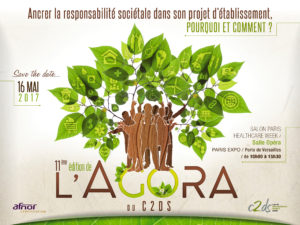
Agora 2017: anchoring corporate social responsibility in your business project
The 11th C2DS Agora took place on May 16, 2017 at Paris Healthcare Week. Organized in partnership with AFNOR Certification, it showcased the first French feedback on societal responsibility in healthcare and medico-social establishments.
Eco-organization DASTRI, new C2DS partner
C2DS has signed up a new partner, the eco-organization DASTRI. DASTRI provides self-treatment patients and users of self-tests for the diagnosis of transmissible infectious diseases with special containers called "needle boxes" for the collection and processing of sharps waste.
An exhibition of works for European Sustainable Development Week
To mark its participation in the European Week for Sustainable Development from May 30 to June 5, SAS Saint Roch is organizing an exhibition of works created by patients as part of their monthly museum outings in its new reception area on Thursday June 1.
More than carpooling
For the past five years, a dozen patients from the hemodialysis center at the Hôpital privé Nord Parisien have been sharing an ambulance. The reasons for adopting simultaneous transport of several patients are numerous: to reduce the number of transports and hence the cost to the health insurance system, to limit the production of greenhouse gases, and to create links between patients.
The EMAS adventure continues
Attesting to their long-term commitment, the Saint-Roch and Clementville clinics have just jointly renewed their EMAS* registration for a further 3 years, making them one of just a dozen healthcare and medical-social establishments currently registered in France.
100,000 low-carbon menus
In 2015, during a day of commitment to COP 21, the 1,200 low-carbon meals prepared by Clinique Pasteur for patients and staff literally had a beefy (or rather anti-befy, given that this meat is the most polluting source of protein) effect.
Sustainable development commitments in a healthcare center or cluster
On March 18, at its national congress, the Fédération française des Maisons et Pôles de santé (FFMPS) presented the leaflet "Engagements développement durable en Maison ou Pôle de santé" (Sustainable development commitments for health centers), produced in cooperation with C2DS. The FFMPS aims to raise awareness among all self-employed healthcare professionals grouped together in "maisons et pôles de santé".