
Centimeo is a single-serve dispenser of eco-responsible snacks made in France and payable with red coins (cents): biodegradable chewing gum made in Angers, organic cookies made in Normandy, fair-trade chocolate, etc. The operation is entirely free of charge for establishments. The dispenser mounts like a picture on the wall, and requires no power supply.

BUY RESPONSIBLY
Since 2015, the "Responsible Purchasing Commitments" campaign has been offering signatory establishments the chance to make sustainable and supportive purchases in favor of protecting the biosphere.
Taking action against violence against women, a commitment by the Les Cèdres medical and surgical center in Brive-la-Gaillarde
Together with the NGO Gynécologie Sans Frontières and the town of Malemort-sur-Corrèze, the Clinique des Cèdres organized a symposium entitled "Réunir les maillons de la chaîne. Pour une meilleure coordination de la prise en charge des violences conjugales" on November 25, 2015, to mark International Day for the Elimination of Violence against Women.
Reduce absolutely but intelligently
Two examples of establishments that have decided to commit to the fight against food waste.
5 star chefs for the Polyclinique du Parc Rambot
As part of the October Rose campaign, the Polyclinique du Parc Rambot in Aix-en-Provence offered all patients undergoing breast cancer surgery a meal prepared by one of the five Michelin-starred chefs taking part in the campaign.
Systematic energy management at Poitiers University Hospital (ISO 50001)
Poitiers University Hospital has embarked on an ISO 50001 energy management certification process, due for completion in spring 2016. The doubling of the energy saving certificate (CEE) bonus represents an additional incentive to complete the process.
Territorial anchoring, a CSR component
Dr. Joël Cliche, President of SAS Saint-Roch in Cambrai (Clinique Saint Roch) is a local player both within the walls of his structure and beyond, as specified in the C2DS guide on the social responsibility of healthcare establishments published in June 2015.
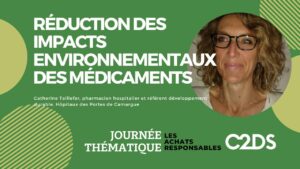
Theme day: responsible purchasing commitments
Catherine Taillefer, hospital pharmacist at Hôpitaux des Portes de Camargue, presents the facility's appropriation of the Persistence, Bioaccumulation and Toxicity (PBT) index for drug molecules for aquatic environments launched in 2013. Find the link to the video in this article.
Center Hospitalier Gabriel Martin (GHGM): a committed facility
The "European Week for Sustainable Development" was followed in the French overseas departments, and in particular on Reunion Island at the Gabriel Martin Hospital, an opportunity for the hospital to demonstrate its SD commitments as part of its Corporate Social Responsibility (CSR) approach, with an awareness-raising day for patients and the general public on June 4. Check out the video shot by the sustainable development working group, which highlights the facility's commitment to sustainable development.
Understanding and respecting plant biodiversity
The CRRF La Châtaigneraie's "inventory of plant biodiversity in the park" is an inventory carried out by two students, the aim of which is to produce a document listing all the plant species in the park, together with a description sheet.
Adopt two hens for sustainable development
In the parking lot of the Polyclinique de Blois on June 1, 2015 from 6pm to 9pm. 208 families applying for adoption will receive their offspring: two laying hens of the Sussex and Noirottes breeds, very greedy. And that's the key to the whole operation. A hen can reduce the volume of household waste by up to 40%, i.e. around 300 kg of "reused" food waste per year!
Share your dashboards?
As the 13 French facilities currently EMAS-registered say, the approach has enabled them to structure themselves, obtain a coherent overall view and, above all, set up indicators adapted to the facility's operations and have a dashboard. Contact the network coordinator to receive the scorecards of EMAS-registered C2DS members.
Listen or re-listen to: "Sustainable healthcare facilities: what are the issues, what are the levers for action, what is the feedback for sustainable energy performance?"
Schneider Electric, a C2DS partner since 2013, organized the April 2015 webinar on "Sustainable healthcare facilities: what are the issues, what are the levers for action, what is the feedback for sustainable energy performance?" You can listen or listen again to the webinar in this article.
Agora 2015: the impact of climate change on human health
C2DS Agora 2015 focused on the health impacts of climate change.
Campaign "Which baby cosmetics for the maternity ward?"
In 2008, the C2DS studied the contents of baby gift sets offered to expectant mothers, and discovered a veritable toxic cocktail of substances, some of them classified as CMR, in the samples of cosmetics, baby bottles and other gifts given by brands to mothers for their babies.
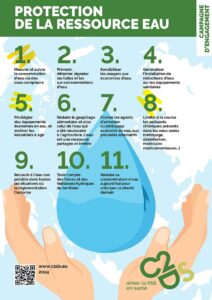
PROTECTING WATER RESOURCES
Since 2015, C2DS has been asking you to get involved in protecting water resources. Thanks to a working group formed within the network, a campaign built around ten actions is at your disposal.
Eco-pasturing, 100% natural maintenance with sheep
Hospitals in France are using... ecological mowers - sheep - to maintain their green spaces. The aim is to save money on the upkeep of green spaces, while helping to preserve certain species of sheep, such as the Ouessant or Solognot sheep, with the added bonus of lowering the establishment's overall CO² emissions.
Clinique Pasteur de Toulouse, the first regional company to receive the PNNS label
As part of the National Nutrition and Health Program (PNNS) rolled out in France by the Ministry of Health, local authorities and companies can receive a label for exemplary commitments and actions in the field of nutrition and physical activity.
A bonus for electric and hybrid vehicles
From April 1, 2015, it is possible to benefit from a bonus of up to 10,000 euros for the purchase or lease of an electric or hybrid vehicle over two years old, replacing an old diesel vehicle. An opportunity for healthcare and medico-social establishments? It certainly is. Electric and hybrid vehicles are particularly well-suited to healthcare professionals who travel a lot, over short distances: self-employed nurses, staff of large facilities, etc.
Fabrice Broutin, Healthcare Segment Manager, Schneider Electric France
Fabrice Broutin, healthcare segment manager, Schneider Electric France, talks about the healthcare sector's awakening to energy issues.