The Clinique de Montberon is a psychiatric clinic with a long-standing commitment to CSR, and is one of only a handful of healthcare establishments to generate electricity. The clinic takes care not only of its patients, but also of its employees. Benefiting from an exceptional setting north-east of Toulouse, patients, often on medium-term stays, can take their minds off their illnesses by indulging in botanical activities in the clinic's therapeutic greenhouse.
Supervaltech clinic's garbage problem
The Supervaltech clinic has identified local service providers, both for recycling paper, batteries and WEEE through a social enterprise, and for compacting cardboard and reselling it in bales. Above all, the clinic has reduced its hazardous waste by 25%.
Take the plunge
At Clinique Victor Hugo in Paris, the 'young' sustainable development committee, set up at the end of 2016 and headed by two nurses, chose to raise staff awareness of energy costs through a fun, educational initiative involving an online quiz.
Recyclable compounds from medical devices: ideas for action
At CHU de Rennes (35), the DM recycling initiative involves sorting and recycling metal waste from operating theatres, such as the copper contained in electric scalpels and the stainless steel contained in laryngoscope blades. This initiative helps to finance the purchase of soft toys for hospitalized children, to make their time in the operating room less dramatic. The metals are recycled by a local company for the benefit of the association "Les P'tits Doudous du CHU de Rennes".
Why it's so important to sort bio-waste
Sorting biowaste at source is the only way to guarantee quality sorting and divert biowaste from landfill or incineration. Biowaste is non-hazardous waste, but landfilling it emits methane, a powerful greenhouse gas, into the atmosphere. Organic recovery, on the other hand, treats biowaste in a sustainable way, returning the compost from composting or the digestate from methanization to the soil.
Ask yourself the right questions .... and find the answers.
Medicamentsdansleau.org is an awareness-raising project developed around the Bellecombe pilot site in Haute Savoie. The ambition of this project, built collectively with health professionals, water professionals, elected representatives and local residents, is to build messages around the issue of medication in water.
Controlling food waste
How does it work to sustainably reduce food waste and intelligently recycle bio-waste in medical and social establishments? The community of communes of the Ambert district in the Puy-de-Dôme region has taken the problem head-on, with an action plan implemented in six retirement homes and ESATs in its area. The results are spectacular: a 10-tonne reduction in food waste since the start of the project for the six establishments, 23 tonnes of composted waste, i.e. 33 tonnes of waste avoided.
Clinique Pasteur - 100,000 low-carbon meals
As part of the "gourmet" 2017 European Sustainable Development Week, Clinique Pasteur (31) will be offering its employees and patients a tasty, low-carbon meal on June 3. This initiative, spurred on by COP 21 in 2015 by the clinic along with other private establishments in Toulouse, has federated other local players over the years. Also this year, 100,000 low-carbon meals will be prepared by the collective restaurants of Greater Toulouse, a large-scale operation supported by Ademe.
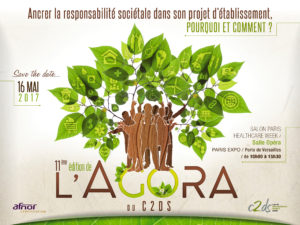
Agora 2017: anchoring corporate social responsibility in your business project
The 11th C2DS Agora took place on May 16, 2017 at Paris Healthcare Week. Organized in partnership with AFNOR Certification, it showcased the first French feedback on societal responsibility in healthcare and medico-social establishments.
Eco-organization DASTRI, new C2DS partner
C2DS has signed up a new partner, the eco-organization DASTRI. DASTRI provides self-treatment patients and users of self-tests for the diagnosis of transmissible infectious diseases with special containers called "needle boxes" for the collection and processing of sharps waste.
Waste: free of charge and transfer of responsibility thanks to eco-organizations
Eco-organizations are private companies operating in the public interest, approved by the State and remunerated by producers subject to Extended Producer Responsibility (EPR). Each offers a collection and treatment service, generally free of charge, for one or more categories of waste. C2DS partners include Corepile, Ecologic, Eco-mobilier, Récylum and Valdelia. Here's an overview of the key eco-organizations for your establishments.
An exhibition of works for European Sustainable Development Week
To mark its participation in the European Week for Sustainable Development from May 30 to June 5, SAS Saint Roch is organizing an exhibition of works created by patients as part of their monthly museum outings in its new reception area on Thursday June 1.
ISO 26000 reading guide for medical-social establishments
Discover the space dedicated to the ISO 26000 reading guide for medical-social establishments. You'll find an educational video to help you understand social responsibility and its international standard, feedback from Nathalie Ronzière (Deputy Director of the Cannes Hospital) and answers to frequently asked questions. Of course, you can also download the reading guide.
More than carpooling
For the past five years, a dozen patients from the hemodialysis center at the Hôpital privé Nord Parisien have been sharing an ambulance. The reasons for adopting simultaneous transport of several patients are numerous: to reduce the number of transports and hence the cost to the health insurance system, to limit the production of greenhouse gases, and to create links between patients.
The EMAS adventure continues
Attesting to their long-term commitment, the Saint-Roch and Clementville clinics have just jointly renewed their EMAS* registration for a further 3 years, making them one of just a dozen healthcare and medical-social establishments currently registered in France.
100,000 low-carbon menus
In 2015, during a day of commitment to COP 21, the 1,200 low-carbon meals prepared by Clinique Pasteur for patients and staff literally had a beefy (or rather anti-befy, given that this meat is the most polluting source of protein) effect.
Sustainable development commitments in a healthcare center or cluster
On March 18, at its national congress, the Fédération française des Maisons et Pôles de santé (FFMPS) presented the leaflet "Engagements développement durable en Maison ou Pôle de santé" (Sustainable development commitments for health centers), produced in cooperation with C2DS. The FFMPS aims to raise awareness among all self-employed healthcare professionals grouped together in "maisons et pôles de santé".
Recycle your used electrical equipment and kitchen furniture
Valo Resto Pro® is a global collection and recycling scheme for the "professional kitchen and catering" sector, as well as an environmental quality label, attesting to producers' commitment to managing the end-of-life of their marketed equipment (collection, depollution, recycling) in a way that respects the environment and the law.
Energy performance now
With a move to new buildings scheduled for the end of 2018, Clinique du Tonkin's sustainable development committee, more active than ever, has been looking for a project to limit energy consumption with a rapid return on investment.
Five goats are better than a lawnmower
The Beaujolais polyclinic has a vast field adjoining the parking lot, which needed to be maintained. The management decided to take an interest in eco-pasturing, contacted Cascade Paysage and welcomed 5 goats from the Massif Central, renowned for their ability to graze even in thickets (and 2 kids were born in 2017).