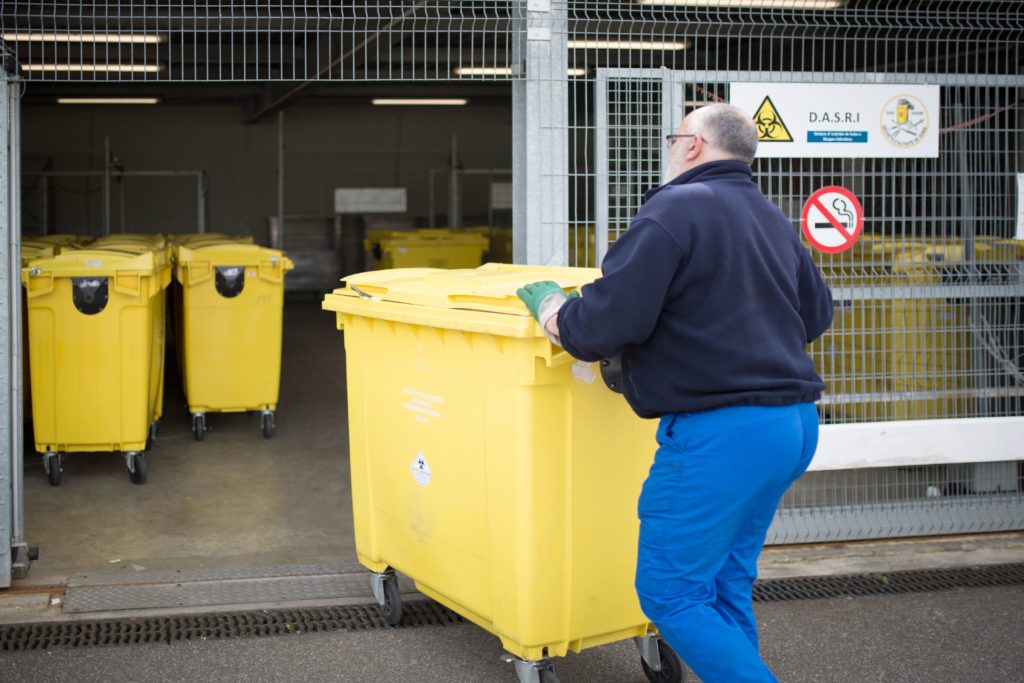
For almost ten years, the Dijon University Hospital (21) has been implementing a rigorous policy to reduce the amount of medical waste generated, under the guidance of Florent Guillemin, Waste Management, Transport and Logistics Manager. Today, 266 tonnes of medical waste are sent each year to the incineration center a few kilometers away, whereas the volume of infectious waste produced by the CHU exceeded 400 tonnes in 2010. The Covid-19 crisis is having a major impact on volumes, and is leading us to take up a new challenge.
" The monthly tonnage collected in March increased until May, and doubled for the month of April!" explains Florent Guillemin. " Dijon University Hospital welcomed 2,451 patients hospitalized following the Covid-19 crisis, including 184 in intensive care. As a result, our volumes of infectious waste increased significantly, due to the massive and necessary use of protective equipment. A health crisis reinforces the pressure of infectious risks and psycho-emotional feelings, and naturally encourages hyper-vigilance, sometimes to the detriment of more rational behavior that also guarantees health safety. During the Covid-19 crisis, many of the sorting systems set up over the years were abandoned by our staff, who are normally very involved, and the volume of DASRI for the months of March to May doubled, rising from 20 to over 40 tonnes in April alone. This situation not only results in a loss of resources, since 90% of medical waste can normally be recycled (a medical waste bag is essentially made up of cardboard, paper and plastic), but also represents a considerable additional cost for the CHU, since the cost of processing one tonne of medical waste is four times higher than one tonne of household waste. All in all, years of effort are now being put on hold. Will we be able to return to the good practices we had before Covid-19? How long will it take?
"I hope that this pandemic will enable us to take a fresh look at our practices, starting with purchasing and then moving on to waste management. Over the past few weeks, we've had some interesting experiences in our region, which we may need to continue once the Covid-19 wave has passed. Agreements with regional companies have enabled us to develop and source washable masks and gowns - a simple way of reducing single-use and waste volumes! Furthermore, the law governing the disposal of infectious waste dates back to 1997, a period that was permanently marked by the contaminated blood scandal, and which had already imposed hyper-security with regard to infectious waste and encouraged the use of single-use products. Many countries in Europe have long since adopted much more flexible legislation concerning HIW. In France, some waste treated as HIW in hospitals is, mainly for logistical reasons, treated as household waste if it is produced in the city, which does not call health safety into question. Once the pressure is off, I hope that we will be able to reflect on our behavior towards our waste in times of crisis, so as to define precise protocols to be respected should a new wave come along. A period of reflection would have been necessary at the start of the Covid-19 wave, but frankly we were all surprised by the scale of the crisis. "