ARC-EN-CIEL FOUNDATION
Communication and staff involvement: the keystones of the Sustainable Development approach
La Arc-en-ciel Foundation is made up of twelve establishments throughout the Burgundy-Franche-Comté region, grouped by activity. It has set up working groups, including one dedicated to sustainable development, made up of twelve members responsible for liaising with each of the establishments to which they belong. "In addition to these referents, we regularly recruit project ambassadors who are able to support the Group's actions within their respective establishments. We have been entrusted with a number of missions, including reducing and recycling our waste, cutting our energy consumption, preserving our water resources and improving air quality," explain Christelle Barton and Fabienne Lucotte, co-leaders of the Foundation's SD group.
In 2023, the DD Group organized its Sustainable Development Week, a large-scale project involving the Foundation's 12 establishments. Christelle Barton and Fabienne Lucotte share their experiences with the C2DS Communication Club.
C.B: "We chose themes based on four elements: water, air, earth and fire. Above all, we had to assess how many people in-house could participate and get involved in the workshops, because we really needed people. In September, after several inter-school meetings, we drew up the communication plan. For each theme, the sites ran participatory workshops, games, site visits, exhibitions and even a serious game.
Communication and professional involvement are key to the project's success.
C.B: " Communication was very important, with the creation of logos, posters for each facility, plans of the various stands, flyers, e-mail signatures, newsletters, and above all numerous coordination meetings with all the teams". The organization was consequent, with a busy schedule and deadlines that were sometimes too short to deploy the actions in the twelve facilities.
"The communications department had to work in a hurry. Sometimes we had to create the communication materials ourselves, with the members of the SD group, or even the spouses. But everyone worked together: technicians, hygienists, organizers... Staff participation and involvement were really important".
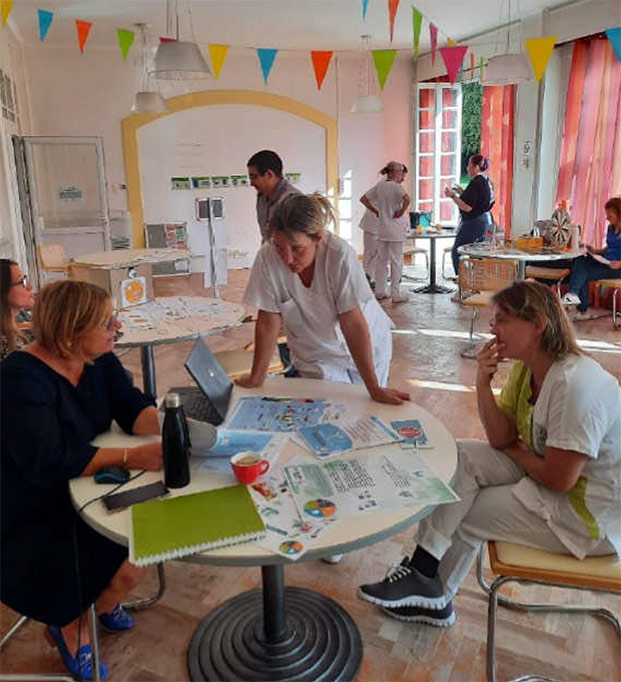
The Foundation also focused on communicating with patients in their rooms who have difficulty getting around. " We used a placemat on the tray to explain the week's activities ," explains Fabienne Lucotte, hotel and catering manager and head of logistics at the health center. We also set up a "Birth of a sustainable world" exhibition in the hall. We have also created a shared compost for the day care and PASA services. We have also raised awareness of eco-actions among patients and professionals. Each department worked as a team to choose an eco-gesture. For example, we no longer throw away the water served in carafes during meals, but use it to water the vegetable garden or green plants".
Thematic workshops to raise awareness among healthcare professionals, patients and users.
F.L: "With regard to waste, we contacted Sydom, Sytevom and Cyber. They offered fun workshops to raise patients' awareness of waste reduction and good sorting practices. There was also a workshop on composting. Young people attending the institute were able to visit the Maison de la Nature and the waste recycling plant. There was a "clean up nature" operation in the villages and institutes, and a quiz on food waste. On the theme of water, the foundation's technical department showed a film on types of water, mains water, trajectory, water treatment, monitoring, legionella risks, consumption and cost.
On the theme of air, "Our low-carbon lives" workshops raised awareness of the carbon and greenhouse gas footprints of everyday life. "It was really an exchange to try to think collectively with all the patients on five items such as food, transport, housing, consumption and public services. We tried to raise patients' awareness of air pollution, both indoors and outdoors. This was an opportunity for the hygienists to present the actions implemented by the Foundation to limit pollution in buildings, including the reduction in the use of chemicals, water-based biocleaning of floors and steam cleaning.
A serious game to raise awareness of the need to reduce energy consumption
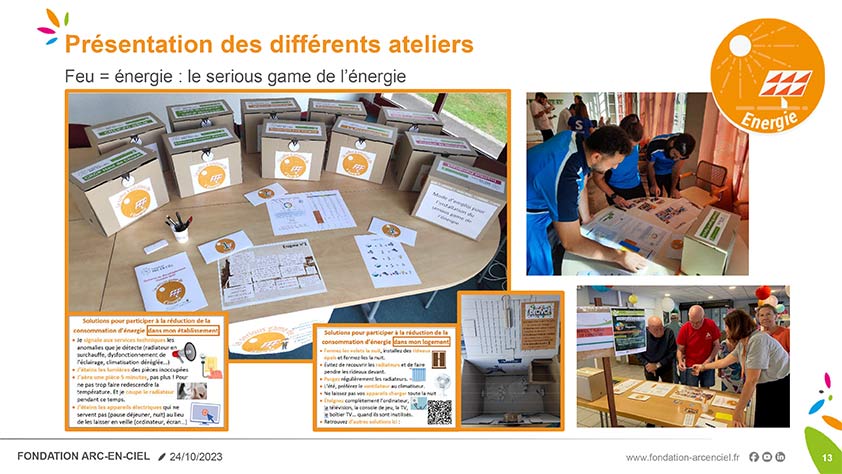
C.B:"With our technical advisor in energy saving, who works on all the sites, we built an energy serious game, common to all the establishments. It was accessible to all caregivers, as well as to young people, patients and independent people. The aim of the game was to open a safe to retrieve a solution card for reducing our energy consumption within the facility and in our personal homes. There were three riddles to solve. One on the history of energy, one on the different sources of energy and one on the different eco-actions that could be taken".
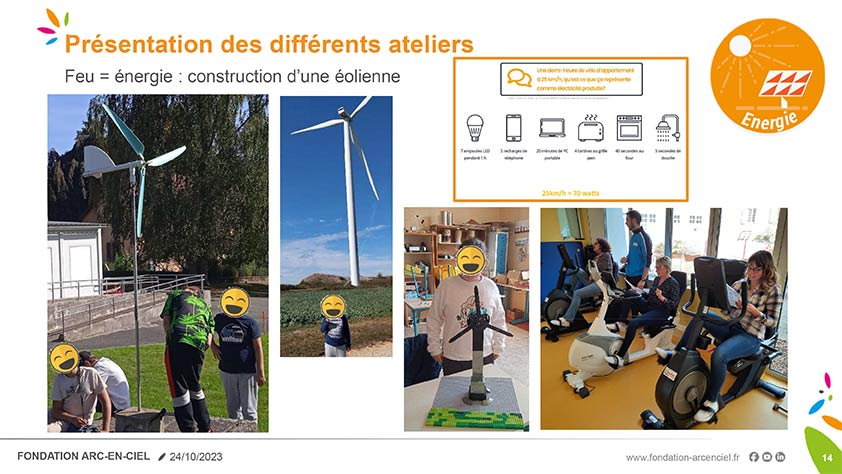
The foundation also organized a visit to two wind farms and a workshop to build a wind turbine prototype. "In a center for frail patients, a cycloenergy workshop was organized. The aim was to convert time into energy, to raise awareness of the time it takes to meet our various needs. For example, we had to pedal for half an hour at 25 km/h to recharge three phones.
The European Week for Sustainable Development was a real success, with excellent feedback from patients, residents and healthcare professionals. For Fabienne and Christelle, it was the multi-disciplinary work that was interesting: "It's a time for sharing, enabling us to implement common actions and share ideas to move forward a little faster. We realize that many professionals are interested in the approach and would like to get involved, but don't necessarily know how to go about it. Now, SD Week is set to become a must-attend event!